Communism Didn't Make China Rich. It Made China Poorer Than Chad.
In 1980 China was one of the ten poorest countries on earth. What changed was not the party in charge but the arrival of markets, private business, stock exchanges and property rights.
In 1980, China was one of the ten poorest countries in the world. By the World Bank's measure of GDP per person at market exchange rates, the average Chinese produced about $195 that year. That put China seventh from the bottom of the 163 countries with data, poorer than Ethiopia, Burundi, Chad and Rwanda. By then China had spent about three decades, from 1949 to 1978, running one of the most thorough planned economies ever attempted.
The chart below shows China's total GDP in current US dollars, from 1960, when the World Bank series begins, to 2025. Kenneth Rogoff and Yuanchen Yang estimated in a 2020 NBER working paper that real estate and related activity accounted for 29 percent of China's GDP in 2016, or 24 percent when the external sector is excluded.
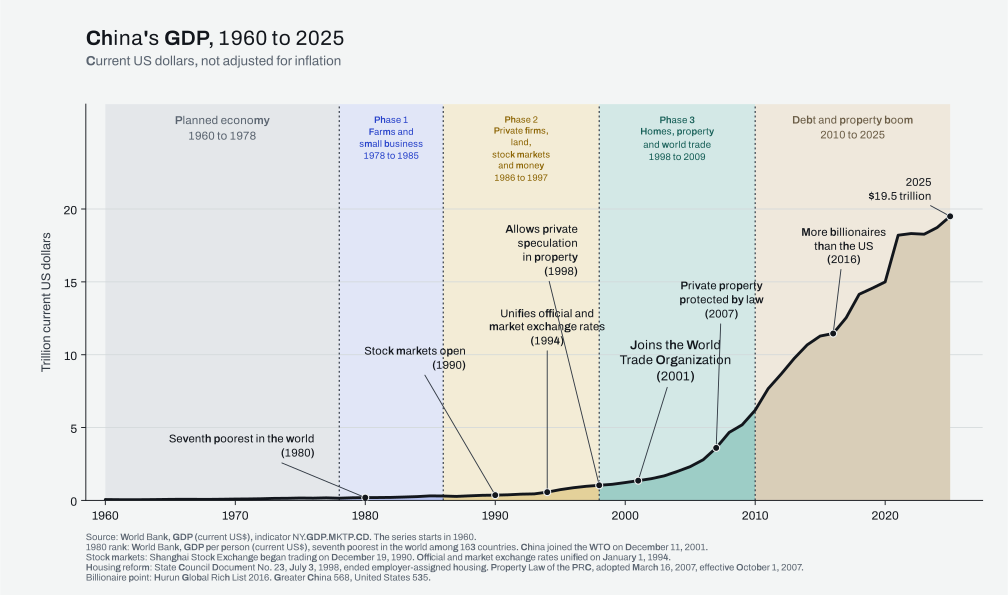
I bring this up because of a story I hear often: China is now an economic superpower and the Communist Party is still in charge, so communism must deserve some of the credit. I think the timeline says the opposite. China became rich in the years when it let markets back in, one reform at a time, and each of those reforms is something a textbook would call capitalism, while the same party stayed in power.
Three decades of the plan
When the People's Republic was founded in October 1949, China was poor but not uniquely so. Using the Maddison Project's long-run estimates, which adjust for differences in prices between countries, China's income per person in 1950 was about the same as much of Africa and South Asia. It ranked roughly 20th from the bottom of 146 countries.
Then came the plan. Land was collectivized, private business was absorbed by the state, and prices, output and jobs were set from above. The early recovery years were decent: income per person grew about 2.7 percent a year from 1952 to 1957. After that, the record is dominated by two catastrophes, the Great Leap Forward from 1958 to 1962 and the Cultural Revolution from 1966 to 1976. According to the World Bank, GDP per person fell 26.5 percent in 1961 alone, and it fell again in 1962, 1967, 1968 and 1976.
Across the whole planned era, from 1952 to 1978, income per person grew about 2 percent a year on the Maddison measure. That is slow for a country starting so far behind. At market exchange rates, which is what a Chinese family would have felt when trading with the rest of the world, China in 1978 was poorer than 37 of the 39 sub-Saharan African countries the World Bank had figures for. Only Burundi and Somalia were lower.
The famine reversal
The moral case for communism has always rested heavily on food. Markets, the argument goes, distribute food unfairly. Some people eat well while others go hungry, and a planned system would fix that by feeding everyone according to need.
The largest famine in recorded history happened in China under exactly that kind of system. Between 1959 and 1961, during the Great Leap Forward, tens of millions of people starved. The statistics from the period are unreliable, so estimates vary. Peng Xizhe estimated about 23 million excess deaths. Ashton and colleagues, and separately Judith Banister, put it near 30 million. The Chinese journalist Yang Jisheng, in his book Tombstone, settled on 36 million. The historian Frank Dikötter, working from party archives, put it at no fewer than 45 million.
What makes this famine so damning for the planned economy is how it happened. Local officials reported inflated harvests to meet political targets, and the state then took grain based on those fictional numbers. Communal dining halls, where "eating is free," burned through stores in the first months. Grain exports continued while people starved. Economists Xin Meng, Nancy Qian and Pierre Yared found that China produced enough food in aggregate to avoid mass death, and that mortality was actually higher in regions that grew more food per person. Their conclusion is that the rigidity of central procurement explains at least half of the deaths. The system designed to share food fairly was the direct cause of the deaths.
Other planned economies had their own famines. The Soviet Union went through famine in 1921 and 1922, again in 1930 to 1933 (somewhere between 5.7 and 8.7 million deaths, including the Holodomor in Ukraine and a famine that killed roughly 38 to 42 percent of all ethnic Kazakhs), and again in 1946 and 1947. Cambodia under the Khmer Rouge, Ethiopia under the Derg in 1983 to 1985, and North Korea in the 1990s each suffered mass starvation too.
I want to be fair here, because this argument is easy to overstate. Market economies and colonial empires have had terrible famines too. Bengal in 1943, under British rule, killed somewhere between 1.5 and 3 million people, even though food production that year was higher than in a famine-free year shortly before. The economist Amartya Sen, who studied Bengal closely, drew the most useful lesson from it: "No famine has ever taken place in the history of the world in a functioning democracy." His point is about accountability, a free press and governments that can be voted out.
My claim is narrower than saying capitalism prevents famine or that every communist country starved, and I think it is harder to dodge. The system sold as the cure for unfair food distribution produced the worst famines of the twentieth century, again and again where it collectivized farming. When one collective authority controls every bushel and no one can contradict it, a bad decision does not get corrected. It gets enforced.
The reforms, in three phases
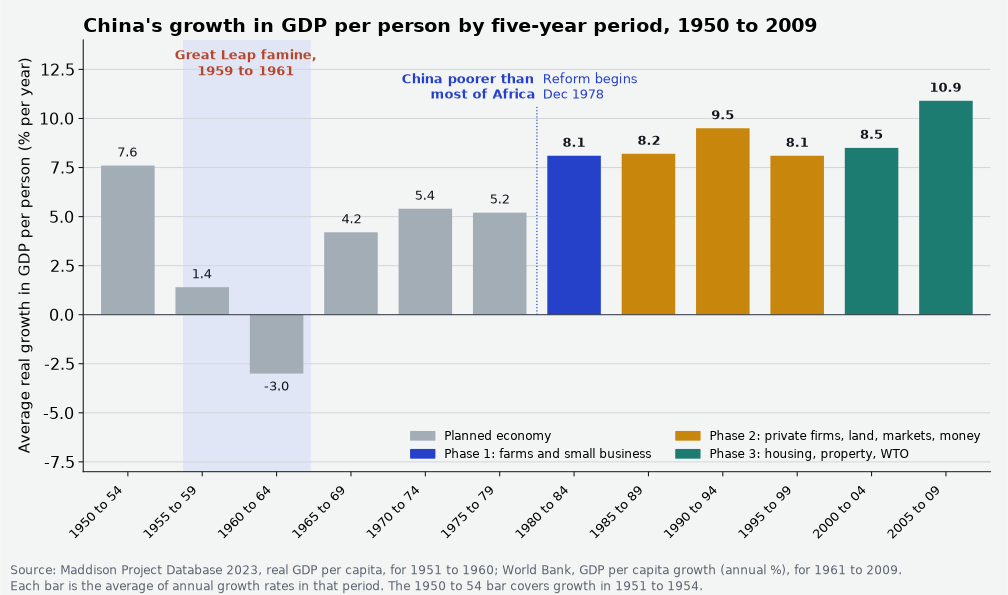
In December 1978, the Third Plenum of the party's Central Committee launched what became known as "reform and opening up." What followed was a sequence of steps over three decades, and almost every one of them handed a decision back from the state to households, firms or markets. The chart below shows China's real growth in GDP per person in five-year periods going back to 1950. Under the plan, growth swung between a postwar rebound, the Great Leap collapse (an average of minus 3.0 percent a year from 1960 to 1964) and recoveries, and it averaged 3.2 percent a year from 1961 to 1978, according to the World Bank. The colored bars mark the three reform phases described below.
Phase 1: Farms and small business, 1978 to 1985
Farming came first. In 1978, eighteen households in the village of Xiaogang in Anhui province secretly divided their collective land so that each family could keep what it grew beyond a quota. The idea, later called the household responsibility system, spread from 1979 and was made official in 1982. Farmers who could keep their surplus started producing one.
Small private businesses came next. Individual businesses, called getihu, were legalized starting in 1979, and rules issued in 1981 let them hire up to seven people from outside the family. The first Special Economic Zones opened in 1980 and 1981 in Shenzhen, Zhuhai, Shantou and Xiamen as places where foreign capital and market prices could operate. In 1985 China's first venture capital firm, China New Technology Venture Investment Corp, was founded.
The gains built over a few years. Growth in GDP per person was 6.2 and 6.5 percent in 1979 and 1980 and slipped to 3.8 percent in 1981, then climbed to 7.4, 9.2, 13.7 and 11.9 percent from 1982 to 1985 as the farm reforms became official and spread. On the chart, the five-year average rose from 5.2 percent in 1975 to 1979 to 8.1 percent in 1980 to 1984.
Phase 2: Private firms, land, stock markets and money, 1986 to 1997
A firm with eight or more outside employees counted as a private enterprise, and those were not fully legal until a constitutional amendment in April 1988 recognized the private economy. The same amendment opened the door to a property market. On December 1, 1987, Shenzhen had held the first public auction of a state land-use right: a 50-year right to an 8,588 square meter plot, sold for 5.25 million yuan. The 1988 amendment made such transfers legal nationwide. Urban land still belongs to the state, but under national rules issued in 1990, a residential land-use right can run for up to 70 years and can be sold, mortgaged and inherited. A right that lasts for decades and can be bought, sold, borrowed against and left to your children works much like the Western idea of owning property under the protection of the state.
Capital markets followed. The Shanghai Stock Exchange was re-established in November 1990 and began trading on December 19, 1990. The Shenzhen Stock Exchange was founded on December 1, 1990 and formally opened in July 1991, and a securities regulator, the CSRC, followed in October 1992. Deng Xiaoping made his Southern Tour in early 1992 to push the reforms forward.
Money changed too. China had a currency, the renminbi, from the very beginning, so this reform was about letting money work as money. Until 1993, city dwellers needed government grain coupons as well as cash to buy staple food. Those coupons were abolished nationwide on April 1, 1993. In 1994 China unified its official and market exchange rates, and on December 1, 1996 it made the renminbi convertible for trade and other current transactions under the IMF's Article VIII.
The five-year averages in this phase were 8.2 percent for 1985 to 1989, 9.5 percent for 1990 to 1994 and 8.1 percent for 1995 to 1999, even with growth of only 2.6 and 2.4 percent in 1989 and 1990. Single years reached 12.9 percent in 1992 and 12.6 percent in 1993.
Phase 3: Homes, property and world trade, 1998 to 2009
In 1998 the State Council ended the system in which employers assigned housing to workers, which turned housing into something people bought, sold and borrowed against. The same year, a proposal by Cheng Siwei in China's top advisory body put venture capital on the national agenda. Constitutional amendments in 1999 and 2004 called the non-public sector an "important component" of the economy and added protection for lawful private property. China joined the World Trade Organization in December 2001, passed a Property Law in 2007 and opened ChiNext, a Nasdaq-style board for young growth companies, in Shenzhen in 2009.
The five-year averages were 8.5 percent for 2000 to 2004 and 10.9 percent for 2005 to 2009, the highest on the chart, with a single-year peak of 13.6 percent in 2007.
What happened to growth
Taken together, from 1979 to 2009 China's real GDP per person grew an average of 8.8 percent a year, nearly three times the planned-era rate of 3.2 percent. In dollar terms, GDP per capita at market exchange rates went from $157 in 1978 to $969 in 2000, $4,629 in 2010 and $13,293 in 2024. By 2000 China ranked 68th from the bottom of 204 countries. On the more conservative Maddison measure, income per person grew about 1.7 times over the 26 planned years from 1952 to 1978 and about 11 times over the 44 years from 1978 to 2022. The Communist Party kept full political control throughout, and what changed was who decided what to grow, make, charge, invest in and own.
A country of billionaires
If you want a single sign of how far China moved from Mao's economics, count its billionaires. By the count of the Hurun Global Rich List, which tracks Chinese wealth closely, China has had more billionaires than any other country in most years since 2016, when it first passed the United States, 568 to 535. Hurun's 2026 list puts China at 1,110. A country that once banned private firms with eight or more outside employees now has one of the largest billionaire populations on earth.
Sweden, often held up as a model of social democracy, has about 4.7 billionaires per million people on Forbes's 2026 list. That is more per person than any other country with over 10 million people, and well above the United States at about 2.9 per million. A generous welfare state can sit alongside a market economy that produces large fortunes, which is a different thing from central planning.
Education under the plan
There is one real example: education. Average years of schooling for Chinese adults rose from 1.8 in 1950 to 5.7 in 1980, according to the long-run estimates compiled by Barro, Lee and colleagues. South Korea is a useful check. In 1950 its income per person was close to China's ($998 against $799 in the Maddison estimates), and its adult literacy, about 38 percent, was below China's 48 percent. Under a market economy, Korean adults went from 4.6 years of schooling in 1950 to 8.6 in 1980, a slightly bigger gain than China's, and by 1980 Korean income per person was about three times China's ($6,064 against $1,930). If a market economy matched China's schooling gains while growing far richer, I find it hard to give communism the credit for them.
What the record shows
Three decades of central planning left China one of the ten poorest countries on earth and produced the deadliest famine in history. Over the following three decades, China legalized family farming, private business, venture capital, stock markets, a usable currency, a property market and the right to own a home, and growth in income per person nearly tripled for a generation. The country that once rationed grain with coupons now has more billionaires than any other country by Hurun's count. The same Communist Party ran China before and after 1978, and the growth came after it changed the economic rules toward markets.
Sources
- World Bank, GDP per capita (current US$): https://data.worldbank.org/indicator/NY.GDP.PCAP.CD
- World Bank, GDP per capita growth (annual %), China: https://data.worldbank.org/indicator/NY.GDP.PCAP.KD.ZG?locations=CN
- Maddison Project Database 2023: https://www.rug.nl/ggdc/historicaldevelopment/maddison/releases/maddison-project-database-2023
- Our World in Data, average years of schooling: https://ourworldindata.org/grapher/mean-years-of-schooling-long-run
- Our World in Data, literacy rates: https://ourworldindata.org/grapher/cross-country-literacy-rates
- Our World in Data, famine dataset: https://ourworldindata.org/the-our-world-in-data-dataset-of-famines
- Great Chinese Famine, overview and estimates: https://en.wikipedia.org/wiki/Great_Chinese_Famine
- Meng, Qian and Yared, "The Institutional Causes of China's Great Famine," Review of Economic Studies (2015): https://doi.org/10.1093/restud/rdv016
- South China Morning Post on Dikötter's estimate: https://web.archive.org/web/20161023142821/www.scmp.com/article/723956/revisiting-calamitous-time
- Soviet famine of 1930 to 1933: https://en.wikipedia.org/wiki/Soviet_famine_of_1930%E2%80%931933
- Cameron, "The Kazakh Famine of 1930 to 33": https://doi.org/10.21226/t2t59x
- University of Warwick, Famine in Russia 1921 to 1922: https://warwick.ac.uk/services/library/mrc/collections/digital/russia/famine/
- Famines in British India: https://en.wikipedia.org/wiki/Timeline_of_major_famines_in_India_during_British_rule
- Leavitt, review of Sen on famine and democracy, Impact (2012): https://impact.scholasticahq.com/article/122016-sen-amartya-ed-_peace-and-democratic-society_.pdf
- New York Times, "Does Democracy Avert Famine?": https://www.nytimes.com/2003/03/01/arts/does-democracy-avert-famine.html
- Household responsibility system: https://en.wikipedia.org/wiki/Household_responsibility_system
- Garnaut, Song and Fang, China's 40 Years of Reform and Development (ANU Press): https://press-files.anu.edu.au/downloads/press/n4267/html/ch18.xhtml
- Constitution of China and its amendments: https://en.wikipedia.org/wiki/Constitution_of_China
- Special economic zones of China: https://en.wikipedia.org/wiki/Special_economic_zones_of_China
- Shanghai Stock Exchange: https://en.wikipedia.org/wiki/Shanghai_Stock_Exchange
- Shanghai Stock Exchange, History and Development: https://english.sse.com.cn/aboutsse/overview/
- Shenzhen Stock Exchange: https://en.wikipedia.org/wiki/Shenzhen_Stock_Exchange
- ChiNext: https://en.wikipedia.org/wiki/ChiNext
- People's Daily on the end of grain coupons: http://politics.people.com.cn/n/2013/1104/c70731-23427676.html
- IMF, China accepts Article VIII obligations: https://www.imf.org/en/news/articles/2015/09/14/01/49/pr9658
- State Council, Notice on Further Reform of the Foreign Exchange Management System, Guofa (1993) No. 89, December 25, 1993, effective January 1, 1994: https://www.gov.cn/zhengce/content/2016-07/28/content_5090286.htm
- People's Bank of China, A Managed Floating Exchange Rate Regime is an Established Policy, July 15, 2010: https://www.pbc.gov.cn/english/130724/2025080815071284369/index.html
- Shenzhen government on the 1987 land auction: http://www.sz.gov.cn/szstory/202301/content/post_10371168.html
- Asian Development Bank, 30 Years of Housing Reforms in the PRC: https://www.adb.org/sites/default/files/publication/28408/economics-wp198.pdf
- State Council, Notice on Further Deepening the Reform of the Urban Housing System and Accelerating Housing Construction, Guofa (1998) No. 23, July 3, 1998: https://www.beijing.gov.cn/zhengce/zhengcefagui/qtwj/201309/t20130924_776668.html
- Interim Regulations on the Assignment and Transfer of State-Owned Urban Land Use Rights (1990), Articles 12, 19, 32 and 48 (English translation): https://www.lehmanlaw.com/resource-centre/laws-and-regulations/real-estate/interim-regulations-of-the-peoples-republic-of-china-concerning-the-assignment-and-transfer-of-the-right-to-the-use-of-the-state-owned-land-in-the-urban-areas-1990.html
- Property Law of the PRC: https://en.wikipedia.org/wiki/Property_Law_of_the_People%27s_Republic_of_China
- National People's Congress, Property Law of the People's Republic of China, English text, adopted March 16, 2007, effective October 1, 2007: http://www.npc.gov.cn/zgrdw/englishnpc/Law/2009-02/20/content_1471118.htm
- Hurun Global Rich List 2016 (archived): https://web.archive.org/web/20160430015556/http://www.hurun.net/en/ArticleShow.aspx?nid=15703
- Hurun Global Rich List 2026: https://www.hurun.net/en-us/info/detail?num=FTJ5PSSPOWOF
- Forbes, The Countries With The Most Billionaires 2026: https://www.forbes.com/sites/samellefson/2026/03/11/the-countries-with-the-most-billionaires/
- Kazakh famine of 1930 to 1933: https://en.wikipedia.org/wiki/Kazakh_famine_of_1930%E2%80%931933
- Cultural Revolution: https://en.wikipedia.org/wiki/Cultural_Revolution
- Deng Xiaoping's southern tour: https://en.wikipedia.org/wiki/Deng_Xiaoping%27s_southern_tour
- World Trade Organization, China: https://www.wto.org/english/thewto_e/countries_e/china_e.htm
- Rogoff and Yang, Peak China Housing, NBER Working Paper 27697, August 2020: https://www.nber.org/papers/w27697